
The Problem: A Bellied Sewer Line Under a Richardson Slab
We recently worked on a home in Richardson where a 33-foot section of the main sewer line under the concrete slab had sagged. Plumbers call this a "belly." Instead of running at a steady downhill slope toward the city connection, the pipe dipped in the middle.
That's a real problem for a drain line. Sewer pipes have no pump pushing things along. They rely on gravity, so the slope has to be consistent from one end to the other. A belly creates a low spot where water sits and solids settle out, and over time that spot becomes a magnet for backups.
The tricky part was location. This section ran underneath the foundation, which meant the usual options were either breaking through the finished floors inside or going under the house from outside. The goal was to fix the line without tearing up the interior.
How We Replaced It Without Breaking Up the Floors
Rather than jackhammering through the floors, we went in from outside. Here's how the job was laid out, step by step:
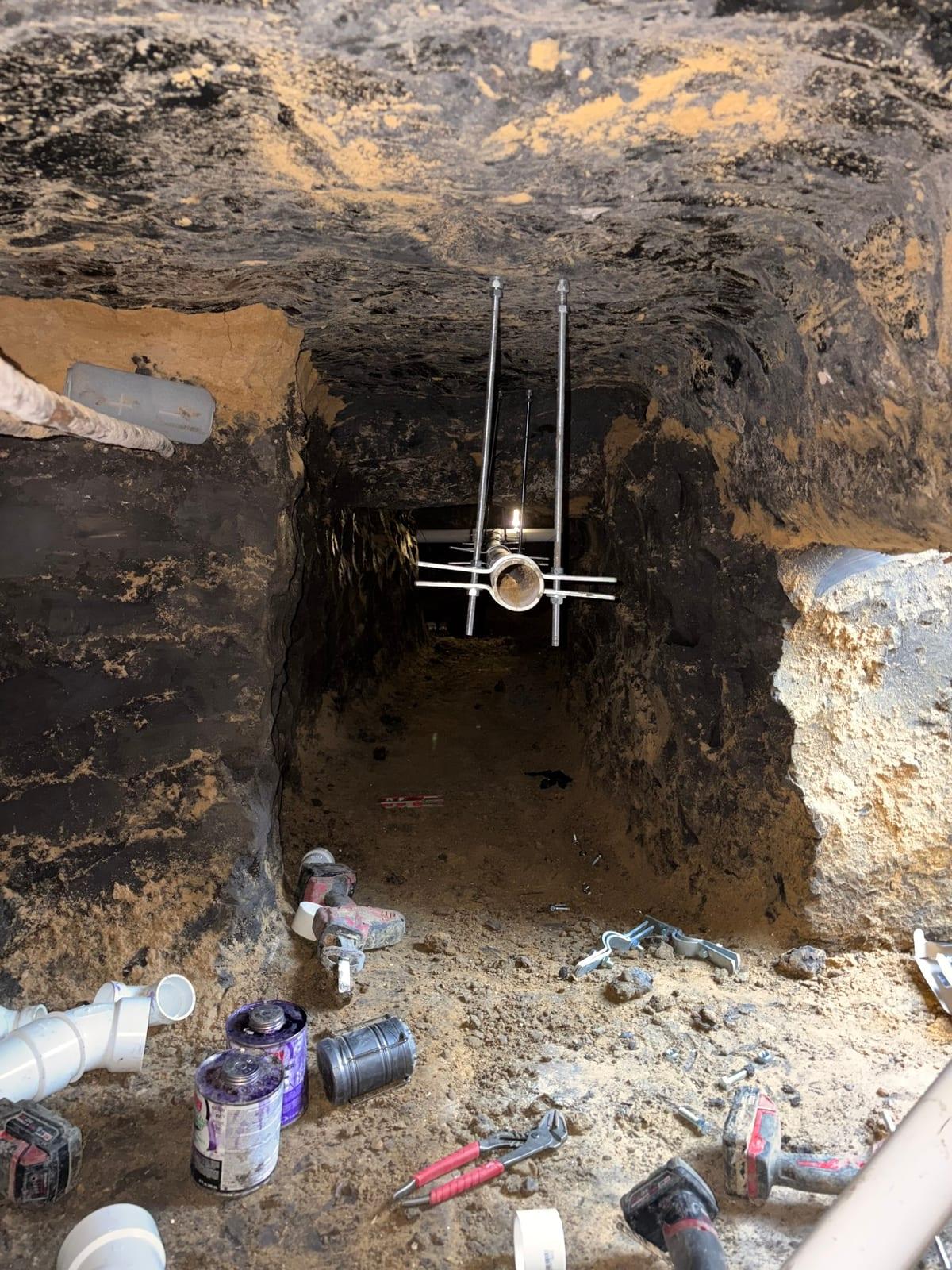
- Hand-dug access pit: A 3-foot by 3-foot starter pit, about 4 feet deep, dug by hand just outside the foundation. This was the single entry point for the whole job, so the inside of the house stayed untouched.
- Tunnel under the slab: A 33-foot tunnel dug by hand beneath the foundation, sized at roughly 3 feet by 3 feet so the crew had safe room to work on the line.
- Removing the bad section: The entire 33-foot bellied stretch was taken out.
- New Schedule 40 PVC: The replacement pipe is heavy-duty Schedule 40 PVC, tied into the healthy sections of the existing drain line on each end.
- Anchored hangers: Corrosion-resistant clevis hangers were mounted with concrete anchors drilled into the underside of the slab, spaced at code-required intervals. That locks the pipe into a permanent downward slope so it can't settle into a new belly.
- Pressure testing: The new section was filled and pressurized under observation to confirm the joints and couplings were watertight before anything was covered back up.
- Main water shutoff: The job also covered the main line emergency shutoff valve, either repairing or replacing the assembly, renewing the exterior valve box, and checking that it opens and closes properly.
- Engineer's review: We coordinated with a licensed professional engineer for an independent look at the tunnel and slab, including a post-backfill inspection and a formal written report.
- Permit and inspection: We handled the sewer replacement permit and scheduled the required walkthrough with the city plumbing inspector.
- Backfill and compaction: The excavated soil was put back into the tunnel and compacted in layers to fill voids and support the slab.
The hangers are the part that matters most for the long haul. Simply laying new pipe back in loose soil can lead to the same sag down the road. Hanging it from the slab itself keeps the slope right where it belongs.
Why Sewer Lines Sag Under North Texas Homes
Bellies aren't unusual around here, and the ground is a big reason. Much of North Texas sits on expansive clay that swells when it's wet and shrinks when it dries out. After a few cycles of drought and heavy rain, the soil under and around a pipe can shift enough to pull it out of alignment.
Other common causes include:
- Soil that wasn't compacted well when the house was built, so it settles over the years
- Poor bedding under the pipe, leaving it without even support
- Leaks that wash away soil around the line and create voids
- Older pipe materials that flex or deform under load
- Foundation movement that drags the pipe along with it
None of this happens overnight. A belly usually develops slowly, which is why it can go unnoticed until drains start acting up.
Warning Signs of a Bellied Sewer Line
A sagging line tends to show itself through repeat drain trouble rather than one dramatic failure. Watch for these:
- Slow drains in several fixtures at once, not just one sink
- Clogs that come back soon after being cleared
- Gurgling sounds from toilets or tubs when other fixtures drain
- Sewer odors inside the house
- Water backing up into a tub or shower when the washing machine or toilet runs
What you can check safely: notice whether the trouble is in one fixture or several. A single slow sink is usually a local clog. Multiple fixtures backing up points to the main line. Beyond that, leave it to a pro. A camera inspection is the standard way to confirm a belly and measure how long it is.
Routine drain cleaning or hydro jetting can clear out a belly temporarily, but it can't change the slope. If the low spot is there, the buildup will return.
Tunneling vs. Breaking Through the Slab
When a sewer line under a slab needs replacing, there are two main ways in: cut through the floor from inside, or tunnel underneath from outside.
Breaking through the slab can make sense for a short repair in a spot that's easy to reach, like an unfinished area. But it means removing flooring, cutting concrete, and dealing with dust and disruption inside the home, then patching and replacing finishes afterward.
Tunneling keeps the work outside and under the house. Floors, cabinets, and fixtures stay put, and the family can usually keep living normally. It's often the better choice for longer runs like this 33-foot section.
A few things affect what a sewer replacement under a slab costs:
- How long the damaged section is and how deep it sits
- Whether tunneling or slab cutting is the better route for the layout
- Soil conditions and how hard the digging is
- Pipe material and the number of hangers needed
- Permits, city inspections, and engineering reports
- Extra items, like work on the main water shutoff
Every house is different, so a proper estimate starts with finding out exactly where the problem is and how big it is.
When to Call a Professional
If your drains keep backing up, clogs keep coming back, or you're smelling sewer gas inside, it's time to have the main line looked at. Under-slab sewer work involves excavation, foundation safety, permits, and inspections, so it's not a DIY project.
Our team handles sewer line repair across Denton and Collin counties and the surrounding area, including tunneling under slabs when that's the smartest way in. Give Sailor's Air & Plumbing a call at (940) 290-3800 and we'll help you figure out what's going on underneath your home.
Want a professional to take a look?
Book online in about a minute, or call and talk it through with someone local.